REVIEW · PAGE
Grand Canyon North Rim Full-Day Self-Guided Tour
Book on Viator →Operated by Shaka Guide Apps · Bookable on Viator
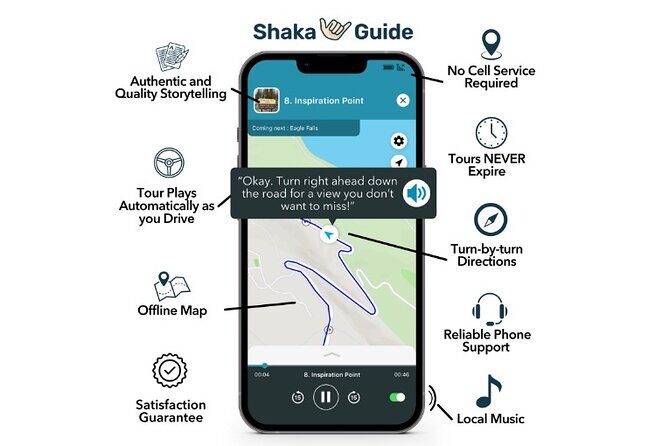
If you like structure but hate rushing, this tour fits. It strings together North Rim highlights with hands-free GPS audio and offline maps.
I like the flexible pacing—you can linger at viewpoints and skip bits that don’t interest you. I also like that the narration gives travel tips as you drive, so you understand what you’re seeing along the way. One drawback: like any app-based experience, you’ll want to download the tour with solid Wi‑Fi first, and you may run into phone issues like a few customers did.
In This Review
- Key points before you go
- A GPS-run North Rim day you can control
- From Marble Canyon to Navajo Bridge: a historic warm-up
- Dominguez–Escalante trails and the “old route” feeling
- Vermilion Cliffs: where the paved day meets rugged backcountry
- Pipe Spring National Monument: museums, gardens, and ranch life
- The Kanab Visitor Center stop: geology and archaeology on your schedule
- Le Fevre Overlook and the Jacob Lake break that actually helps
- Border Store and supplies: plan for a long rim day
- Point Imperial: the highest North Rim payoff
- Cape Royal Road: the cluster of “stop-and-stare” moments
- Cape Final Trail: the easy-ish walk that earns its reputation
- Angel’s Window and the photo pullover you’ll actually use
- Walhalla Ruins and Walhalla Overlook: two stops, different angles
- A choice of rim walks: Cape Royal options to Bright Angel Point
- North Rim Visitor Center: restrooms, exhibits, and a reset button
- Price and value: how $15.99 turns into a cheap way to drive smarter
- Who this North Rim self-guided tour is best for
- Practical tips to avoid the common self-guided glitches
- Should you book this tour?
- FAQ
- How much does the Grand Canyon North Rim full-day self-guided tour cost?
- How long does the tour take?
- Does the tour work offline?
- What’s included in the tour?
- Are Grand Canyon North Rim and Pipe Spring admission fees included?
- What language is the narration?
- Can I cancel and get a refund?
- Are service animals allowed?
Key points before you go
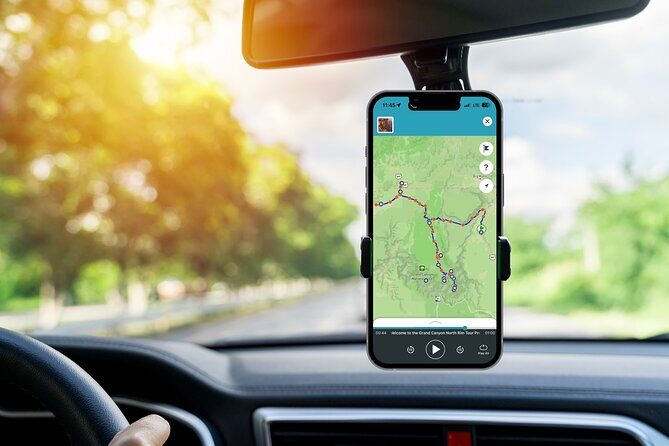
- Offline GPS audio and map mean no data needed once you’re on the road
- Up to 15 people per group for a single group price makes it cost-friendly for family cars
- A story-first route ties together Navajo Bridge, Pipe Spring, Vermilion Cliffs, and North Rim viewpoints
- Short, practical walks (like Cape Final and Bright Angel Point access) keep it doable for most skill levels
- Multiple “break points” for food and supplies (like Jacob Lake Inn and Border Store) keep the day realistic
A GPS-run North Rim day you can control
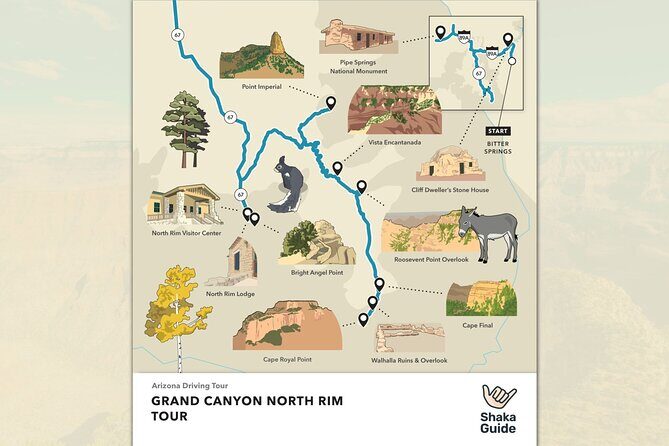
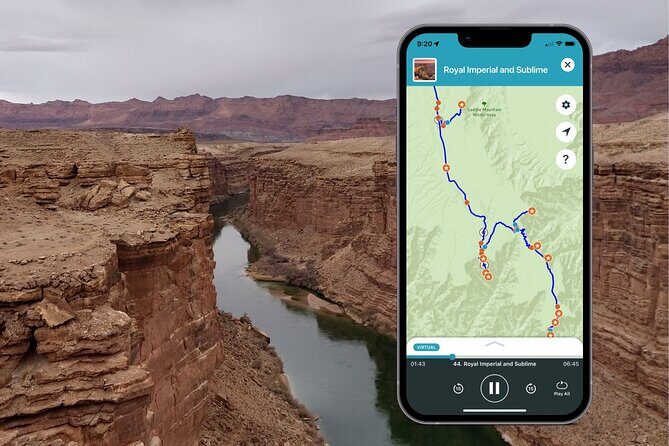
This isn’t a guided bus tour where you have to match someone else’s schedule. It’s built around your drive, with audio that plays automatically as you go and turn-by-turn directions that help you hit the right pullouts.
What that means for you: you can plan a long, slow photo day or keep it brisk and just take the strongest stops. The tour window is wide too—on average it’s booked about 54 days ahead, and the driving time can stretch from roughly 1 hour all the way up to 16 hours depending on how many walking stops you actually do.
Because it’s offline-capable, you’re not stuck hunting for cell service at every turn. You download once (using strong Wi‑Fi), then rely on the offline audio narration and map.
If you're still narrowing it down, here are other tours in Page we've reviewed.
From Marble Canyon to Navajo Bridge: a historic warm-up
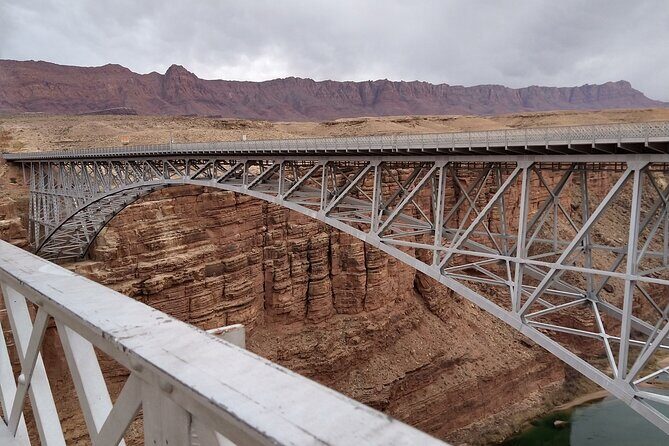
Your route starts back at the Marble Canyon area and then heads into the scenery that leads toward the North Rim. One of the first “wow” stops is Historic Navajo Bridge, built in 1927 to make travel and trade easier across the Colorado River between Utah and Arizona.
You’ll be able to walk across and look down at the river. That’s a nice warm-up because it gets you out of the car early and sets the tone: this trip isn’t just about one big viewpoint—it’s about a chain of places with stories.
Next comes Cliff Dwellers Stone House, a small roadside stop built in 1927 as a makeshift shelter that became a lively lodge for travelers. It’s short, but that’s the point. A quick stop like this keeps your momentum without turning the day into a series of long detours.
Dominguez–Escalante trails and the “old route” feeling
A brief stop on the Dominguez–Escalante Historic Trail area connects you to Spanish priests Francisco Dominguez and Silvestre Escalante, who explored the region in 1776 while searching for a possible trade route from Mexico to California.
This is the kind of stop that feels small until you think about time scales. You’re not just reading about explorers—you’re standing in a place that was part of their route logic, and you’ll likely start noticing how travel corridors shaped settlements and roads.
If you like history but also like moving, this portion hits the balance. The stops here are short enough to keep your day light.
Vermilion Cliffs: where the paved day meets rugged backcountry
Then the route turns toward Vermilion Cliffs National Monument, a huge swath of land covering nearly 300,000 acres. Most people continue on the main drive, but this is where you learn the area isn’t only scenic pullouts—there are rugged, 4-wheel-drive routes connected to attractions like Wire Pass day hikes and a Condor viewing site.
You don’t have to do any off-road driving as part of this audio tour. Still, having that context makes the road feel bigger. It’s like getting the map legend before you start hiking.
A nearby stop is House Rock Valley Overlook, a scenic turnout that gives you a final look at the Vermilion Cliffs and the House Rock Wildlife Area. This is a great “savor the rock” pause before you transition into Kaibab National Forest country, where you’ll feel the elevation shift and the change in vegetation.
Pipe Spring National Monument: museums, gardens, and ranch life
Pipe Spring National Monument is one of the most practical stops on the route because it offers a menu of experiences: museum, historic fort, cabins, garden, and even ranger-led living history demonstrations and talks. You’ll also have the chance to see ranch animals, which can be a huge win if you’re traveling with kids or you just want a change of pace from viewpoints.
Pipe Spring is also where the narration helps you slow down and look around. It’s not just “here’s a building.” It’s about how Kaibab Paiute traditions and Mormon settlers connect to the water that made ranching and settlement possible.
The tour includes about 30 minutes here, which is just enough for a quick walk through highlights and a calm look around before you continue.
The Kanab Visitor Center stop: geology and archaeology on your schedule
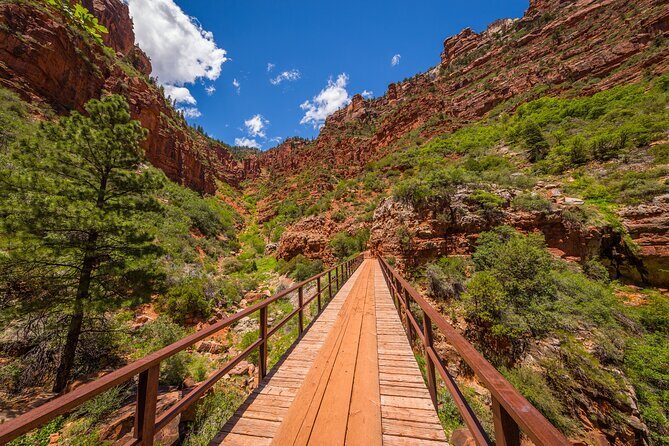
Another stop includes a visitor center within the Grand Staircase Escalante National Monument area—the Kanab Visitor Center. The focus here is geology and archaeology, which is a nice shift from the canyon-outlook focus.
Why this works for you: it helps you read the region. When you later see layers, ridges, and strange formations from the rim, you’ll have a few mental hooks for what you’re seeing.
If you’re the type who likes one short “learn something” stop during a drive, this is that moment.
Le Fevre Overlook and the Jacob Lake break that actually helps
Le Fevre Overlook is a quick roadside view on the way from Fredonia before you reach Jacob Lake. There’s even binoculars, which is unusual for a roadside stop and makes it easier to zoom in on the red-orange bands of the Grand Staircase Escalante.
Then you reach Jacob Lake Inn, a solid legs-stretch and food option. The inn serves breakfast, lunch, and dinner, and its bakery is known for giant cookies. Even if you don’t go all in on food, this stop is valuable because it gives you a predictable moment to reset: water, bathroom, quick snack, and a short walk before the rim viewpoints.
Between those breaks you also get a look at a historic fire tower: an 80-foot Aermotor steel tower built by the Civilian Conservation Corps in 1934. It was used by wildland firefighters and rangers to spot fires from far away, and it’s still open to visitors even though it was decommissioned in the 1970s.
This stop adds a different kind of viewpoint—one that’s about watching the land for danger, not just photographing it for fun.
Border Store and supplies: plan for a long rim day
The Border Store is where you can load up on supplies, snacks, and gas before heading out to the trail and viewpoint stretch.
I like including a supply stop like this in a self-guided plan because the North Rim day can take longer than you expect, especially once you start parking for short walks. If you forget snacks or you run low on gas, you’ll lose time and patience later.
Think of this as your mid-route “don’t regret it later” stop.
Point Imperial: the highest North Rim payoff
Point Imperial is accessed during the drive on the North Rim and is noted as the highest point on the North Rim at 8,803 feet. From here, you’re able to see Boundary Ridge and a central peak called Saddle Mountain.
This is also a good stop if you’re curious about trail routes—because the Nankoweap Trail runs across the lower ridge, and you can see Mount Hayden, Hancock Butte, and Alsap Butte from parts of the upper ridge.
The tour time here is about an hour, which likely works well if you want both looking and a bit of walking. If you’re short on time, you can still get the main payoff without turning it into a long hike.
Cape Royal Road: the cluster of “stop-and-stare” moments
Once you get onto Cape Royal Road, the stops start stacking in a good way. This road has some of the most spectacular North Rim overlooks tucked into about nine and a half miles of paved driving.
Start with Vista Encantada Picnic Area, a quieter viewpoint along Cape Royal Road. It’s known for wildflowers and views of Nankoweap, plus Vista Encantada looks out toward the Walhalla Plateau. On clear days, the narration suggests you may even be able to see the Painted Desert in the east.
Next is Roosevelt Point, accessed through a very short walk with resting benches. Even with the high ridge, the scenery to the north can be impressive, including the far section of the Grand Canyon where the Colorado River forms an unbranched gorge just a mile or so across, cutting into the flat desert plain between the Vermilion and Echo Cliffs.
Cape Final Trail: the easy-ish walk that earns its reputation
If you want a trail that feels worth the effort, Cape Final Trail is the one. It’s a 4-mile out-and-back rated easy, which usually means you’ll be dealing with a less punishing grade than many rim hikes. It’s also shaded in the early portion and winds through Ponderosa pine forest.
At the endpoint, you get the Cape Final Overlook, and people often say it’s among the best looks on the North Rim. In practice, you’re basically going from forest shade to rim openness—an easy recipe for photos and a good break from driving.
If you’re traveling with mixed abilities, this is the kind of trail that often works because the rating is easier and the route is straightforward.
Angel’s Window and the photo pullover you’ll actually use
You’ll also hit Angel’s Window viewpoint, which is a great wide-angle photo stop for the stone arch. The route notes a practical parking cue: park in the pullover on your left to check it out.
This matters on self-guided days. When you’re not with a staff member, those little parking directions save you from looping around and losing daylight.
Walhalla Ruins and Walhalla Overlook: two stops, different angles
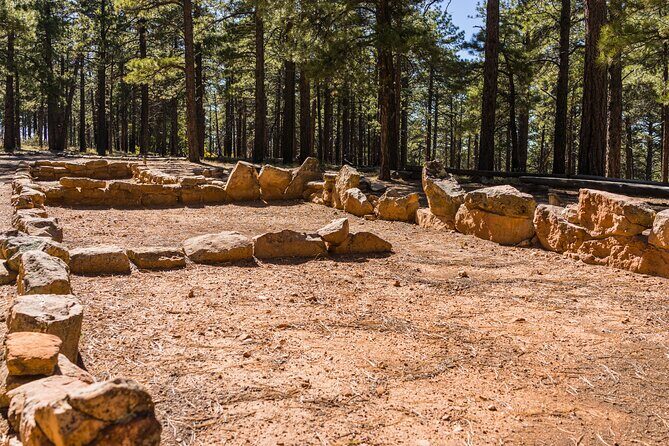
Walhalla Ruins (also called Walhalla Glades) connects the rim scenery to Pueblo period life. You can tour 10 rooms left behind from an older summer home of Basketmakers, and you can catch ranger-led talks and tours through artifacts.
Then cross the road to Walhalla Overlook, which adds broad views of the Echo Cliffs, Painted Desert, and the Little Colorado River Gorge. This pair is smart because the ruins give you “what people did here,” while the overlook gives you “why they chose it”—a view from where you can see distances and corridors.
A choice of rim walks: Cape Royal options to Bright Angel Point
The tour includes more rim hiking choices, so you can tailor it to your energy level.
- Cape Royal Road stretch has a stop time of about an hour, which is best used to move between overlooks slowly and not just speed through the drive.
- Point Sublime is listed as a moderately challenging 32.5-mile out-and-back hike. The tour label suggests about an hour, but given the distance, I’d treat this as an option only if you’re truly set up for a long hike.
- Widforss trail (named for artist Gunnar Widforss) is described as long but relatively flat: 10 miles, with the route starting slightly uphill through forest and then following the rim before dropping into the valley and ending on a plateau for views.
- Uncle Jim Trail is a moderate 4.7-mile out-and-back to the Uncle Jim Trail Overlook. The tour description highlights uneven spots and notes that it’s a popular route for guided mule rides, so you’ll want to watch your footing.
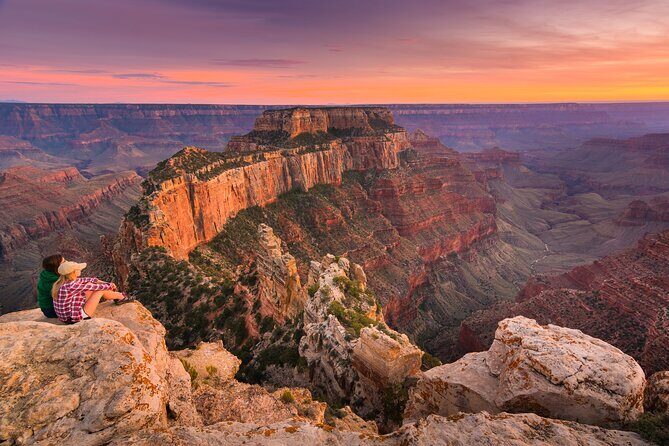
Then comes Bright Angel Point, which the tour flags as the most visited viewpoint on the North Rim. It’s accessed behind the Lodge on the Transept Trail. The path is a half-mile paved route, and at the Point you’ll see three peaks named for Hindu deities: Deva Temple, Brahma Temple, and Zoroaster Temple.
If you want a “big viewpoint moment” without a long hike, Bright Angel Point is often the best move. It’s also a great anchor in your day because it gives you an end-of-drive payoff that doesn’t require deep stamina.
North Rim Visitor Center: restrooms, exhibits, and a reset button
The last major stop on the route is the North Rim Visitor Center. You’ll get parking, indoor and outdoor interactive exhibits, ranger information stations, and a large gift shop—with the very practical bonus of restrooms.
Even if you’ve done plenty of reading, this is the place to confirm current conditions in a simple, human way. On self-guided days, it’s your “check-in” point before you head out.
Price and value: how $15.99 turns into a cheap way to drive smarter
The tour price is $15.99 per group, with capacity up to 15 people. That’s the key value point: it’s not priced per person, and it covers the same offline audio narration and GPS directions for the vehicle group.
But the park fees are separate, and that’s where you should do your math. The provided info lists:
- Grand Canyon North Rim entrance: $35.00 per person (not included)
- Pipe Spring National Monument entrance: $10.00 per person (not included)
So here’s the practical way to think about it. If you’re paying park admission anyway, the tour cost can feel small compared to entry fees. For families or larger groups, the audio tour can make a big difference because it reduces wasted driving and helps you hit the best stops without needing a guide for every person.
Also, the tour never expires. If you don’t finish everything in one day, you can spread it out.
Who this North Rim self-guided tour is best for
This experience suits you if:
- You want a self-paced driving plan with narration doing the work
- Your group includes people with different interests (short history stops, scenic pullouts, plus optional walks)
- You like offline tools and don’t want to rely on spotty cell service
- You’re on a budget and prefer paying once for the audio instead of booking a per-person guide
It might not be ideal if:
- You’re expecting a live guide to answer questions on the spot
- You’re not comfortable with app-based navigation
- Your group only wants to do one or two places and doesn’t care about the scenic “in-between” moments
Practical tips to avoid the common self-guided glitches
A few issues can happen with any phone-based tour. One customer had to switch phones to get it working, but tech support was able to help get them rolling. So my best advice is simple:
- Download the tour ahead of time using strong Wi‑Fi
- Charge your phone before you leave
- Bring a car charger so battery anxiety doesn’t wreck the day
- Start with the route as recommended, then adjust your stop order only if you truly want to
Should you book this tour?
Yes—if you want a value-packed, flexible North Rim road day where the narration keeps the drive meaningful and you don’t want to spend extra money on a live guide. The pricing makes sense especially for groups in one vehicle, and the mix of short history stops plus the best rim viewpoints gives you options even if weather or energy changes.
Don’t book it if you’re aiming for a fully guided, question-and-answer style experience. And do book it with one mindset: you’re the driver, so the app should be your co-pilot. Once you treat it that way, this tour has a lot going for it.
FAQ
How much does the Grand Canyon North Rim full-day self-guided tour cost?
It costs $15.99 per group, up to 15 people.
How long does the tour take?
The duration is listed as approximately 1 to 16 hours, depending on how many stops and walks you do.
Does the tour work offline?
Yes. The audio narration and an offline map are included, and the tour works without needing continuous Wi‑Fi or data.
What’s included in the tour?
You get offline audio narration, GPS turn-by-turn directions, an offline map, recommended highlights (including activity and restaurant tips), and the ability to start, pause, and resume.
Are Grand Canyon North Rim and Pipe Spring admission fees included?
No. Grand Canyon North Rim entrance is listed as $35.00 per person, and Pipe Spring National Monument entrance is listed as $10.00 per person. Parking fees are also not included.
What language is the narration?
The tour is offered in English.
Can I cancel and get a refund?
Yes. You can cancel up to 24 hours in advance for a full refund.
Are service animals allowed?
Yes, service animals are allowed.